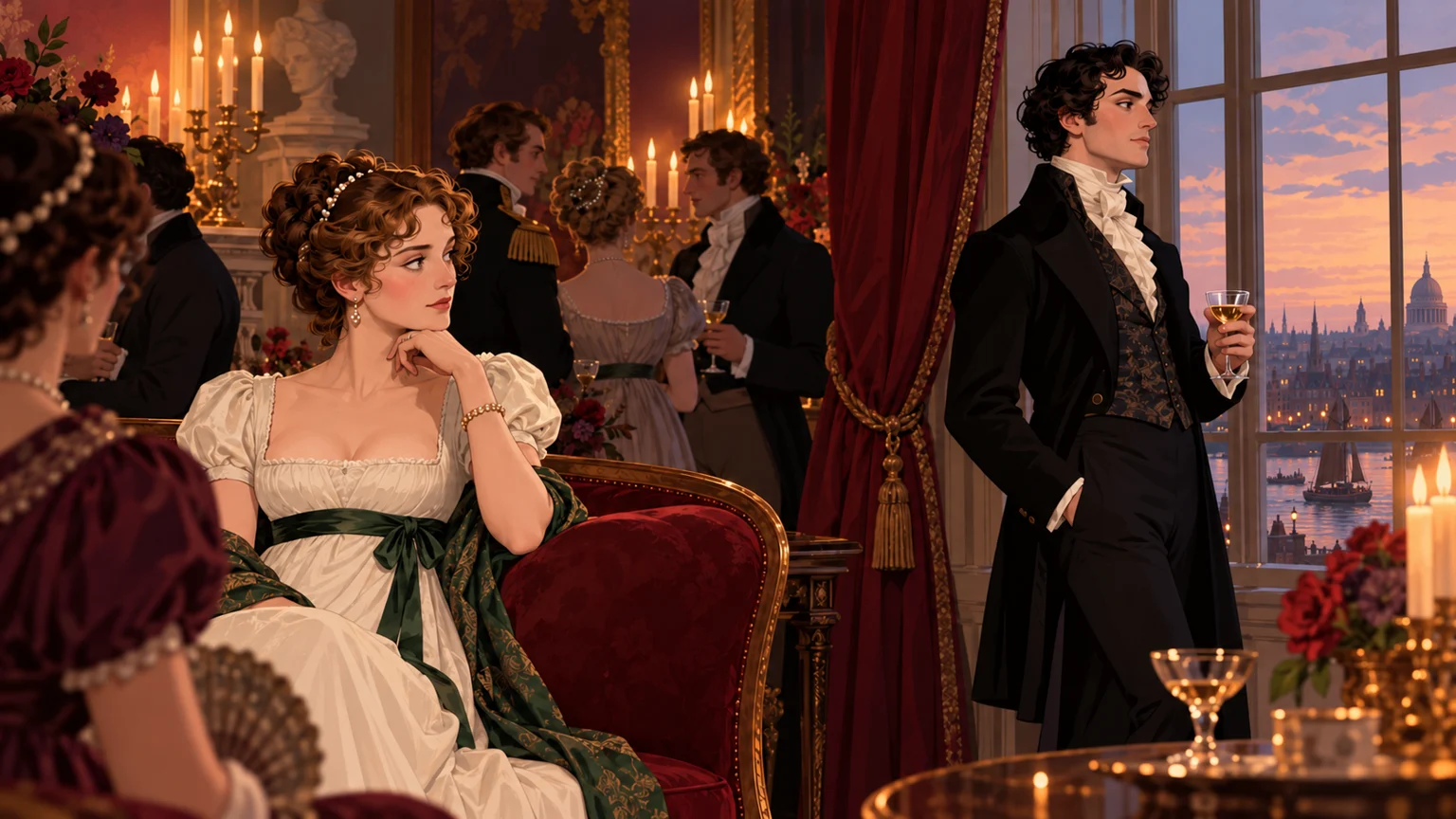
In March 1812, Lady Caroline Lamb met Lord Byron at a London party, went home, and wrote six words in her diary: “Mad, bad, and dangerous to know.”
Then she had an affair with him anyway.
When Byron ended it, Caroline did something I have admired for years. She wrote a three-volume Gothic novel called Glenarvon, cast Byron as the treacherous villain, and included a rejection letter thought to draw on his own parting letters to her. I have a great deal of respect for a writer who makes that rejection part of the manuscript.
I have loved Byron’s poetry since university, to the point where I still know far too much of Childe Harold and Don Juan by heart. When you write Gothic romance, his life and his work explain a problem we still try to solve in almost every book: how do you write a man who makes a woman feel completely understood at the exact moment she realizes she has good reason to fear what he is hiding?
At the same time, Byron is the best cure I know for the worst habit in AI-assisted fiction: the urge to make every character likable.
Byron becomes famous.
Before Childe Harold appeared in the spring of 1812, twenty-four-year-old George Gordon, sixth Baron Byron, was mostly known to his creditors. He had inherited Newstead Abbey at ten with the roof falling in and no money to repair it. When Trinity College at Cambridge told him students were forbidden to keep dogs in their rooms, he bought a tame bear, kept it on a chain in his tower, and suggested the fellows let it apply for a college fellowship. Back at Newstead, his gardener dug up a monk’s skull in the grounds, and Byron had a silversmith mount it as a drinking cup so he could serve claret out of it at dinner.
He was also furiously vain in ways that were completely specific to him. Having weighed over thirteen stone at nineteen, he starved himself on hard biscuits, soda water, and vinegar so he would stay thin, and he went to bed with curl-papers in his hair so London drawing rooms would think his curls happened by accident.
Then John Murray published the first two cantos of Childe Harold’s Pilgrimage. Byron summed up that week in a line every author has envied since: “I awoke one morning and found myself famous.”
Listen to how he introduced Harold in the first canto:
“Yet oft-times in his maddest mirthful mood
Strange pangs would flash along Childe Harold’s brow,
As if the memory of some deadly feud
Or disappointed passion lurk’d below…”
Within two weeks, society women were waiting outside his lodgings in St. James’s and sending him anonymous letters. Caroline Lamb sent one of them. Readers looked at this proud, jaded young nobleman travelling through Europe and assumed that Harold’s unnamed crimes belonged to Byron himself. Byron explicitly insisted in the preface that Harold was fictional. Readers continued to look for him in the poem anyway, and each new scandal gave them another reason to search his writing for a confession.
Readers look for a confession.
His private life gave them plenty to discuss. At Cambridge, the person he loved most had been a younger choirboy named John Edleston, whose death in 1811 left Byron grieving in the Thyrza elegies. Later came affairs with married women, a daughter with Mary Shelley’s stepsister Claire Clairmont, and in January 1815 a marriage to Annabella Milbanke. Annabella loved mathematics, so he called her his “Princess of Parallelograms.” The marriage lasted twelve months.
When Annabella took their infant daughter Ada and left him in January 1816, two ugly rumours ran through London at once. One concerned how he had treated his wife. The other concerned his half-sister, Augusta Leigh.
Biographers still argue over where the physical boundary fell between Byron and Augusta. What survives on paper is his letters and his verse. In the Epistle to Augusta, written after he left England for good in the spring of 1816, he wrote to her:
“My Sister! my sweet Sister! if a name
Dearer and purer were, it should be thine…”
In 1817 he published Manfred. Its protagonist lives alone in the high Alps, commands spirits who cannot help him, and begs for forgetfulness after causing the death of Astarte, the woman who shared his blood and his features:
“She was like me in lineaments; her eyes,
Her hair, her features, all, to the very tone
Even of her voice, they said were like to mine;
But soften’d all, and temper’d into beauty…
I loved her, and destroy’d her!”
Imagine reading those lines in London in 1817, with the separation scandal still fresh in everyone’s mind. Readers felt as if they were listening to a man confess in verse what would have ruined him if he had stated it in prose.
The legend acquires a vampire.
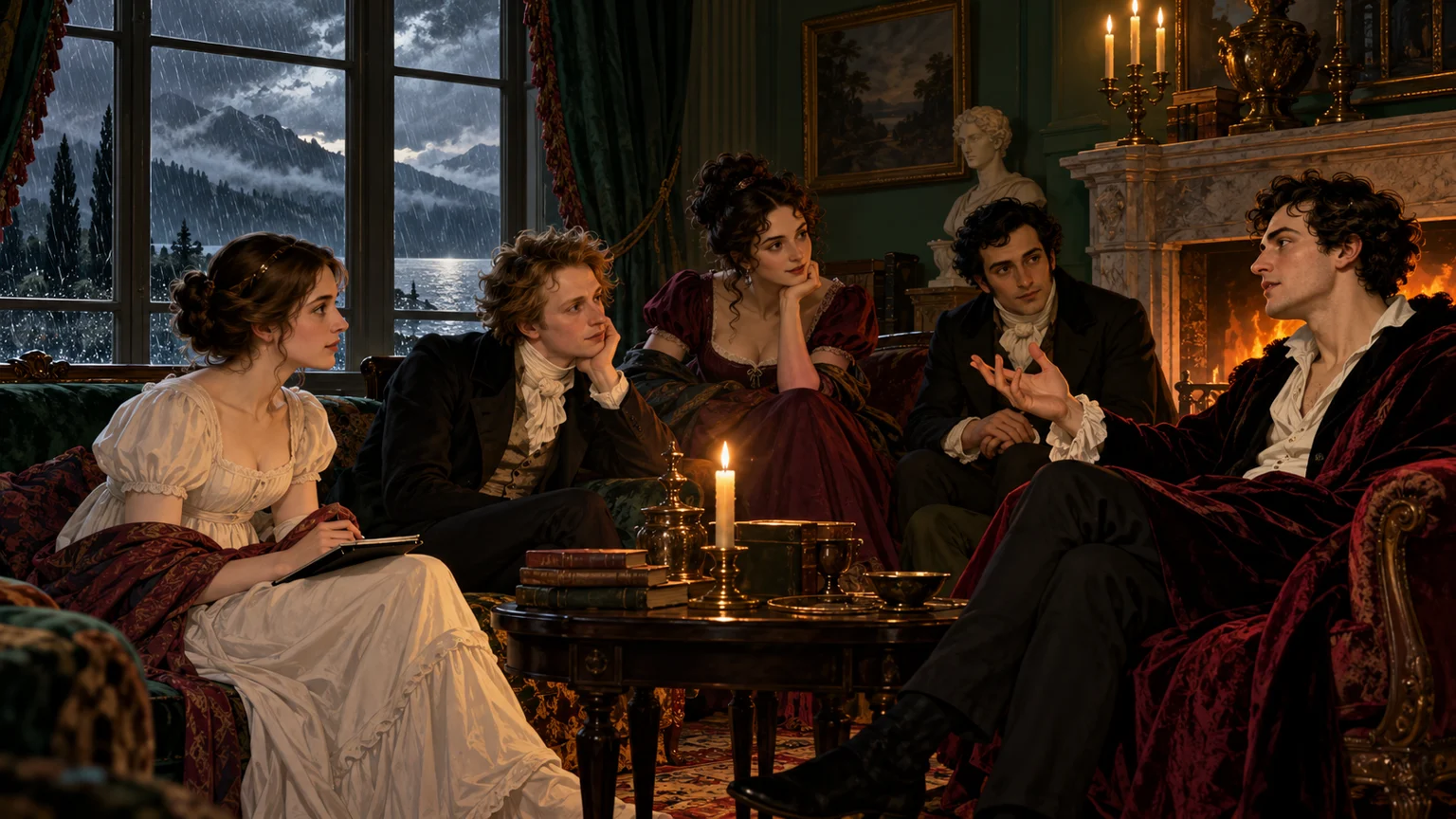
During his first wet summer in exile in 1816, Byron rented the Villa Diodati by Lake Geneva. Percy Shelley, eighteen-year-old Mary Godwin, and Claire Clairmont stayed nearby, and Byron’s twenty-year-old physician, Dr. John Polidori, lived in the house with him. Polidori spent most of the trip admiring Byron one day and resenting him the next.
While the rain kept them indoors, they read old German ghost stories and agreed that each of them would write one. Mary Shelley began Frankenstein. Byron started a short piece about a dying nobleman travelling in the East, lost interest after a few pages, and put the notebook down.
Polidori took Byron’s abandoned idea and wrote The Vampyre. He named his aristocratic blood-drinker Lord Ruthven, which was the exact name Caroline Lamb had used for the Byron villain in Glenarvon. When a magazine printed the story in 1819, the editor attributed it to Lord Byron by mistake. Readers across Europe assumed Byron had written a story about himself as a literal predator, and the aristocratic vampire entered Gothic fiction through a personal grudge and a publishing error.
Even his death left a missing manuscript behind him. He sailed to Greece to help fund the war for independence from Ottoman rule, caught a fever at Missolonghi, and died in April 1824 at thirty-six. Four weeks later, on May 17th, his friends and his publisher met in John Murray’s drawing room at 50 Albemarle Street with Byron’s handwritten memoirs on the table. After an argument, they tore the pages apart and burned the manuscript in the fireplace.
I still find that afternoon at Murray’s infuriating. We have his letters and his poems, and we cannot read what he wrote in those pages to judge it for ourselves. At the same time, burning the manuscript meant that nobody could ever close the question of what he had done.
The model wants to make him likable.
Which brings me to a problem we run into whenever we write with AI today: unlikable characters.
Byron could be petty, cruel to the women who bored him, and reckless with other people’s money. So was Heathcliff, who spent years ruining the lives of the next generation, and so was Mr. Rochester, who locked his first wife in the attic and tried to trick a nineteen-year-old governess into a fake marriage. Characters who have done something genuinely hard to forgive—and women who are angry, calculating, or hiding how sharp they are—give a novel real tension. Yet standard commercial advice is afraid of them, and language models try to erase them on sight.
If you hand a Byronic hero or a calculating heroine to an AI model without strict instructions, the model tries to reform them immediately. By the third chapter, your dangerous man is apologizing for his tone and explaining his childhood feelings. If he has a crime in his past, the model rewrites it into a harmless misunderstanding so the reader cannot blame him. Meanwhile, the heroine gets flattened into a patient caretaker who wants to heal him, or an obnoxious action heroine who insults everyone in the room to prove she is strong.
The machine also forgets that Byron was funny. If you only read Manfred or The Corsair, you meet the solemn outcast:
“He knew himself a villain, but he deem’d
The rest no better than the thing he seem’d.”
If you open Don Juan, you meet a sharp, digressive wit who laughs at everyone’s pretensions, starting with his own. A Gothic hero who only stares out at the rain grows tiresome before page fifty. A dangerous man who also notices how ridiculous other people are is much harder for a heroine to resist.
The heroine has a reason to be afraid.
Let’s put this to work in an invented Gothic premise.
Suppose our heroine paints portraits for her living. A year ago, her sister married the elder son of a wealthy family and vanished on the night of a fire that killed her husband. Searchers never found her sister’s body, and the younger brother inherited the estate.
Twelve months later, the brothers’ mother hires our heroine to paint her portrait. The heroine takes the commission so she can live in the house and find out what happened to her sister. The new owner knows who she is, and he knows a great deal more about the fire than he told the coroner.
Neither of these two is harmless. She is using a paid job to search his house and question his family, hiding her investigation behind the polite manners of a hired painter. He lets her set up her easel in the gallery so he can find out what she already knows, and he stays in the room because he likes watching her work.
During the sittings, whenever the heroine brings up the night of the fire, the mother’s hands begin to shake. Every time, the hero steps in, takes his mother’s arm, and leads her upstairs to rest.
The first twice this happens, the heroine thinks he is a considerate son. By the fourth sitting, she checks her notes and realizes that every single question about the fire has ended with him removing the only witness from the room.
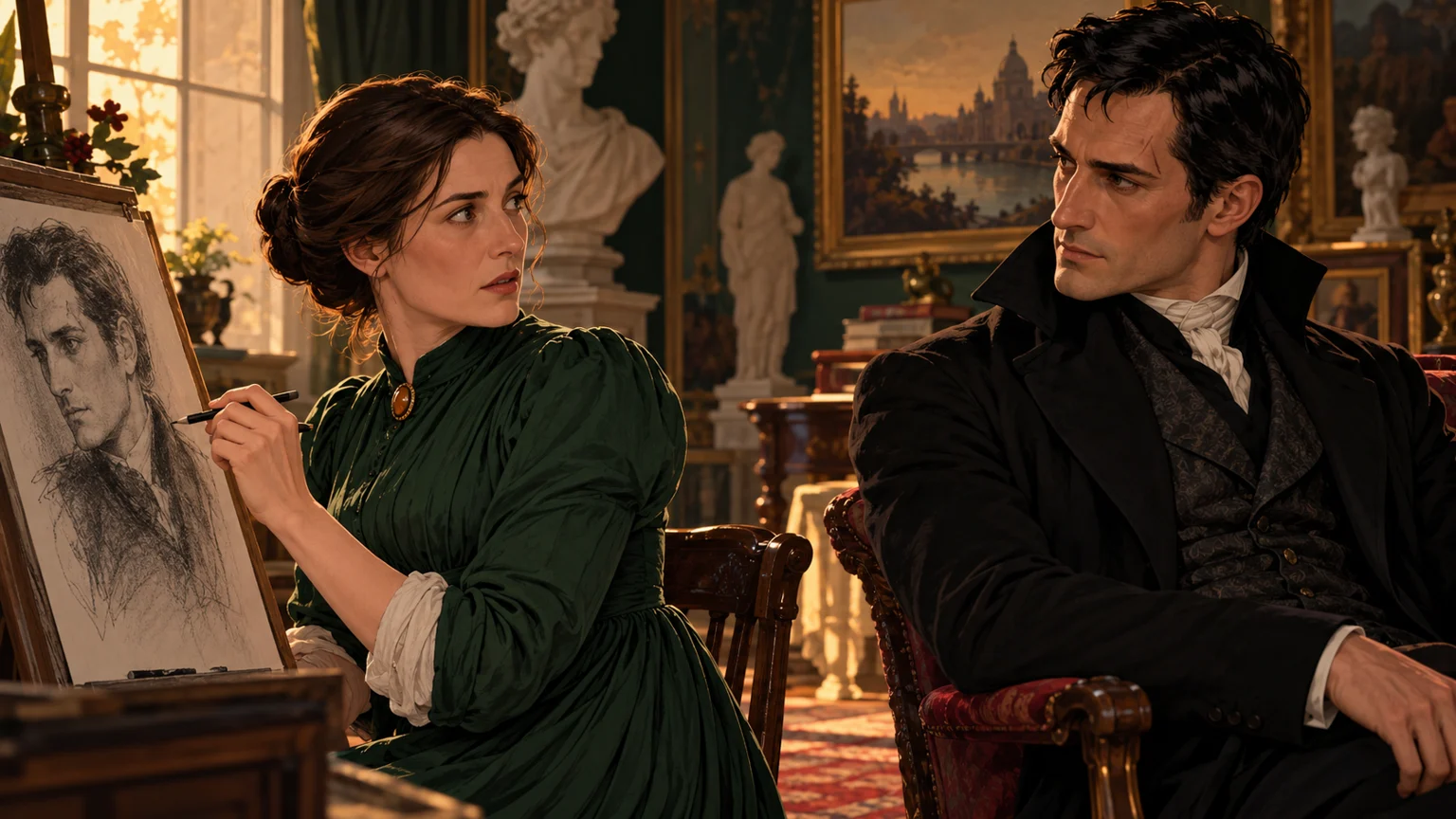
So the next morning, while his mother is resting, the heroine asks him to sit for a quick charcoal study, claiming she needs to check the family resemblance around the eyes. In truth, she wants an hour alone with him.
He agrees and sits for her. While she draws, he talks about one of her earlier portraits, pointing out a difficult choice she made with the shadow across the sitter’s hands. For ten minutes, she forgets her guard and enjoys talking to someone who actually understands her work.
Then he asks how her sister looked at the wedding. Without thinking, the heroine mentions a bruise her sister had hidden under a lace cuff.
He says, “The left wrist.”
She had never told him which wrist it was. And once he says it, he stops answering her questions.
If you ask an AI to finish that outline on its own, it will make him completely innocent: he rescued her sister from the fire, hid her in a safe house, and never harmed anyone. I prefer a secret that leaves real guilt on his conscience. Yes, his older brother was violent, and our hero helped her sister escape on the night of the fire; she is alive abroad, and he has kept his mouth shut because her own family had sent her back to his brother once before, and he did not know yet whether our heroine was part of that betrayal.
Alongside that, I would give him a second fact that is much harder to forgive: when a burning beam fell across his older brother’s bedroom door during the fire, he heard his brother shouting inside, stood in the corridor, and walked away. Then he inherited the estate. Even when the heroine learns her sister is alive, she still has to sit across the table from a man who let his brother burn and would do it a second time.