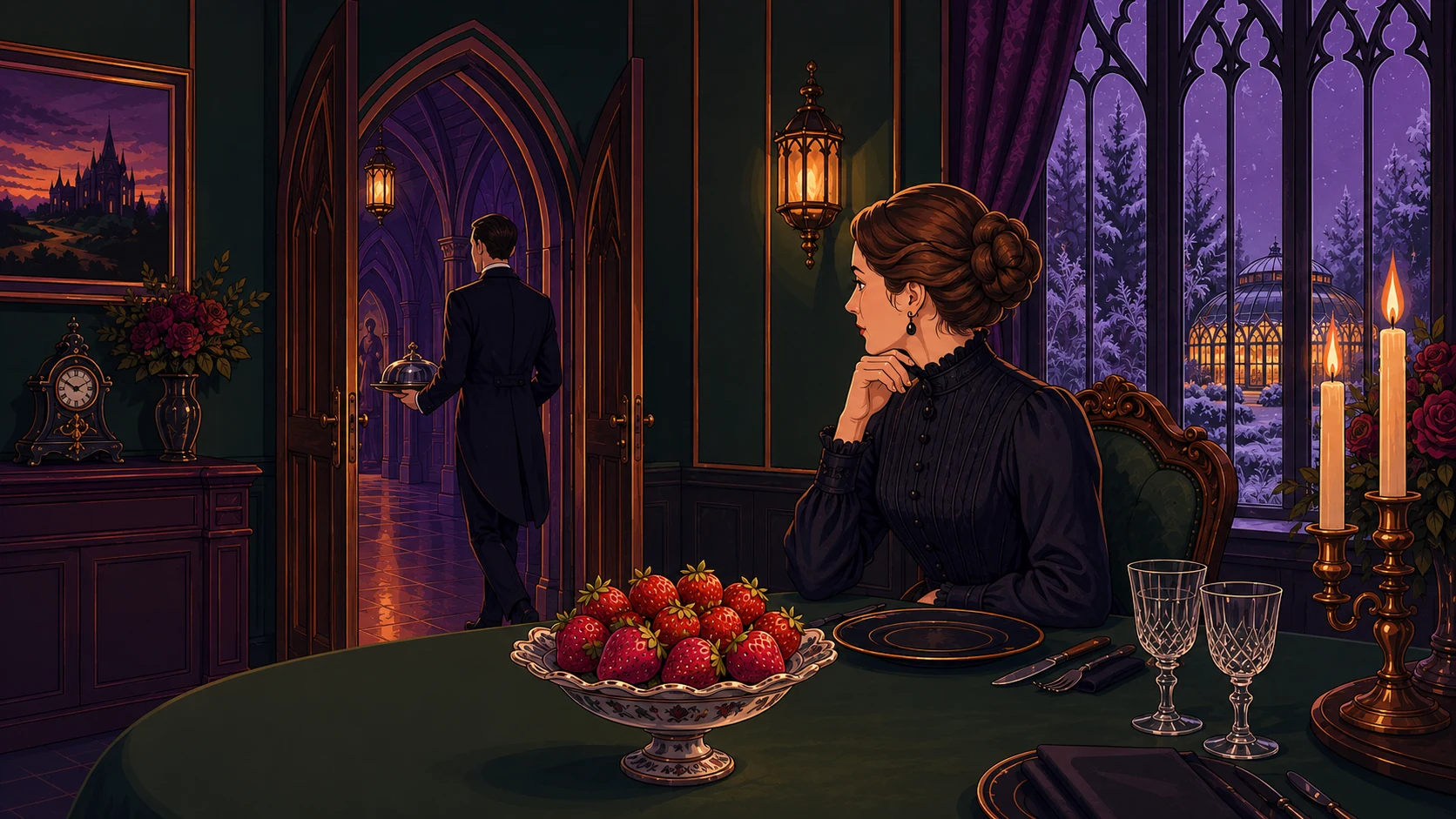
Of all the writing ideas YouTube has offered me, “encode secret plot twists within period-accurate culinary descriptions” may be the first that made me laugh and immediately want to try it.
The suggestion was peculiar enough to raise several useful questions. Could a writer genuinely hide a plot twist in dinner, and could the reader recognise the clues without possessing specialist knowledge of nineteenth-century food?
I wanted the eventual revelation to feel fair. A reader should not need to know the precise significance of a blancmange served on the third Thursday after Michaelmas, and I had no intention of inventing an elaborate Victorian culinary code in which asparagus secretly meant adultery. The food itself needed to provide information that the characters could reasonably observe and interpret.
For the experiment, I therefore set three rules. The dinner had to be plausible for its period, the clues had to arise from details available within the story, and historical knowledge could deepen the reader’s understanding without becoming necessary to solve the mystery.
Because this is Gothic fiction, I also wanted the meal to reveal something more consequential than an excess of soup.
I gave myself an English country house in November 1874, a reduced household, several closed rooms, and a woman who had supposedly died eighteen months earlier. Her husband insists that the estate has changed considerably since her death, but before we decide whether he is telling the truth, we need to know exactly what he claims.
The household’s account
First, we need to know what the household claims to be true
Our heroine has recently arrived at Hartwick Hall, where Sir Edmund Hartwick has been living in seclusion since the death of his wife, Lady Eleanor.
According to Sir Edmund, his wife had been ill for some time and died quietly. He subsequently dismissed several servants, closed the north wing, reduced household expenditure, and stopped heating the glasshouses behind the kitchen garden because maintaining them had become too expensive.
The visible condition of Hartwick Hall appears to support him. Several rooms remain closed, the servant staff is smaller than our heroine expected, and Sir Edmund refers more than once to the expense of maintaining an estate of that size.
Our heroine therefore begins with a clear account of what happened after Lady Eleanor’s death. Any detail at dinner can now be compared with that account rather than functioning as a mysterious clue whose significance exists only in the author’s notes.
Attempt one
Can the menu contain a literal code?
YouTube used the word encode, so I began with the most literal interpretation and tried to make the first letters of five courses spell:
A L I V E
A written menu would be historically plausible. Mrs Beeton describes dinners served à la Russe and states that a menu or bill of fare could be placed beside each guest.
The code itself creates the difficulty. Once the first letters have to spell ALIVE, the choice and sequence of dishes become subordinate to the message. I need an appropriate course beginning with A, another beginning with L, and eventually something beginning with V, whether or not those dishes belong together at an English country-house dinner in November.
Even a historically plausible set of dishes would leave the reader with another problem. Nothing in the story would tell them to examine the first letter of every course unless I deliberately established that method beforehand, and establishing it would draw attention to the existence of the code.
The heroine could eventually announce that the five courses spell ALIVE, but such a revelation would reward an arbitrary method rather than observation. The reader would either detect the code long before she did or remain unaware that there was anything to decode.
So the literal interpretation of YouTube’s suggestion fails rather impressively. I can make the menu spell a word, but I cannot make that word function as fair foreshadowing without constructing an additional puzzle around it.
Attempt two
Can individual dishes carry secret meanings?
The second possibility appears more promising because food can certainly acquire symbolic significance in fiction. A recurring dish may become associated with a person, a family ritual, a death, a courtship, or a particular period in a character’s life.
Problems arise when the author assumes that an ingredient carries a meaning the reader has never been given. If I privately assign pears to fratricide, the pears provide no usable information about a murdered brother until the novel establishes that connection.
Historical fiction creates an additional risk because unfamiliar details can sound authoritative. A modern reader may reasonably assume that an unusual dish, flower, table custom, or ingredient had some recognised nineteenth-century significance when the author has actually invented the association.
That distinction matters if the clue contributes to a mystery. Symbolism can support theme or characterisation, but a fair clue needs an observable connection between the detail and the eventual conclusion.
For this experiment, I therefore abandoned secret culinary meanings and asked a more practical question: what factual information could dinner reveal about Hartwick Hall?
Attempt three
Can dinner contradict what the heroine has been told?
This approach works considerably better because every meal requires identifiable resources and decisions. Someone has obtained the ingredients, someone has prepared them, and servants in a large household have decided where each dish goes and who receives it.
Those facts can be compared directly with Sir Edmund’s claims.
I began with strawberries served at dinner in November. Mrs Beeton’s Book of Household Management pays close attention to seasonality and provides bills of fare for different months. Her November menus contain foods such as cod, oysters, game, apples, and pears, while strawberries appear in summer material rather than in the November menus I checked.
November strawberries were nevertheless possible for a wealthy household. Nineteenth-century British estates used glasshouses and heated structures to extend growing seasons, and horticultural writers had described methods for forcing strawberries well before 1874.
That historical possibility makes the fruit useful because our heroine already knows that Hartwick Hall possesses glasshouses. More importantly, Sir Edmund has specifically told her that they have remained unheated since Lady Eleanor’s death.
When strawberries appear at dinner, our heroine has several reasonable explanations available to her. Sir Edmund may have purchased them from elsewhere, the cook may have found an expensive supplier, or the gardener may have produced them by some method she does not understand.
She asks the butler whether they came from London.
“They are from the south house, miss,” he replies, before correcting himself. “Mr Clarke arranged for them. I believe they came from London.”
The correction is plausible enough to prevent an immediate accusation. The butler may have misspoken, or he may simply know that the gardener arranged the purchase.
Several days later, however, our heroine sees coal being delivered to the boiler house beside the supposedly unused glasshouses. At that point she has a concrete contradiction: Sir Edmund told her that he stopped heating them after his wife’s death, while the estate is currently supplying fuel to the heating system.
She still has several possible explanations for the lie, but she can now establish that at least one part of Sir Edmund’s account is false.
The second clue
A second detail establishes that somebody is ill
During another dinner, our heroine sees a small covered dish waiting near the service area before a footman takes it away. A country house contains servants as well as guests, so one unexplained meal provides little reason for suspicion.
The following evening, another tray leaves during dinner. This one contains toast and a covered cup or bowl, and our heroine recognises the type of meal because she spent several months caring for her father during his final illness.
Mrs Beeton devoted a separate section of The Book of Household Management to invalid cookery, including several preparations of beef tea and instructions intended specifically for sick people. Our heroine requires no knowledge of the book because her personal experience gives her enough information to recognise the purpose of the meal.
Sir Edmund has mentioned no sick guest, relative, or servant, which leaves her with another discrepancy between his account of the household and what she has observed.
At this stage she knows that the glasshouses are still being heated and that somebody at Hartwick Hall regularly receives food suitable for an invalid. Either fact could have an innocent explanation, but the combination justifies further questions.
The third clue
The third clue comes from Lady Eleanor herself
For the final part of the sequence, I would stop relying on historical research and use information the novel has already established about Lady Eleanor.
Earlier in the story, our heroine sees her portrait and later speaks to a former maid who served her for years. During that conversation, the maid recalls Lady Eleanor’s particular fondness for strawberries and explains that she persuaded the gardener to produce them as early and as late in the year as he could manage.
When the maid first mentions this habit, the information simply helps our heroine form a clearer impression of a woman she believes to be dead. Lady Eleanor expected considerable effort from the household, took an interest in the gardens, and especially enjoyed strawberries.
Much later, our heroine learns that the first forced strawberries from the south glasshouse are reserved before dinner and sent upstairs with the invalid’s tray. Sir Edmund receives only the small quantity left over.
The three clues can now support a specific line of inquiry. Sir Edmund lied about closing the glasshouses after his wife’s death, somebody in the house is receiving meals prepared for an invalid, and that person also receives a fruit associated earlier in the novel with Lady Eleanor.
Our heroine still needs to investigate, because inference and proof remain separate. She finally enters the closed north wing and finds Lady Eleanor alive.
The result
Did we actually encode a plot twist in dinner?
In the literal sense of YouTube’s suggestion, the answer is no. The menu contains no cipher, and the dishes possess no secret vocabulary that translates directly into an answer.
The successful version uses dinner to provide factual evidence. The strawberries reveal activity in a glasshouse that Sir Edmund claims to have closed, the separate meals indicate the presence of an invalid, and Lady Eleanor’s established preference connects that hidden person with a woman everyone believes to be dead.
The reader solves no code and requires no specialist knowledge of Victorian horticulture. The important task is simply to remember what the novel has already established and recognise when later details contradict it.
Historical research still contributes to the construction of the clue. It tells the writer whether November strawberries were possible, what their production might require, and what sort of food an invalid might plausibly receive. The novel then gives the reader all the information required to understand why those facts matter in this particular household.
That distinction is especially useful for historical fiction. Research can make a clue accurate and specific without turning the mystery into an examination of knowledge the reader was never given.
Beyond Hartwick Hall
What else can dinner reveal?
Once I had worked through the Hartwick Hall example, I realised that the useful part of YouTube’s suggestion extended well beyond one hidden wife and a dish of strawberries.
Food can reveal financial circumstances because ingredients, preparation, and service have costs. A family that repeatedly claims to be nearly destitute may give the heroine reason for doubt if its meals require resources that appear inconsistent with those claims.
Meals can also reveal the presence of another person. Additional portions, special preparations, unexplained trays, or regular requests from outside the dining room can show that the visible members of a household are only part of the group being fed.
A meal may contradict a timeline as well. Fresh produce from a supposedly abandoned garden, newly prepared preserves, or ingredients requiring recent activity can establish that work continued after the date on which a character claims it stopped.
Food can even provide information about relationships. A character who knows another person’s allergies, dislikes, medical restrictions, or exact preferences possesses knowledge that requires an explanation, especially when the relationship between them is supposed to be distant or nonexistent.
In each case, the writer has to establish the relevant facts before asking the reader to draw a conclusion from them. An expensive ingredient becomes evidence only after the novel makes the household’s supposed poverty clear, while an invalid meal becomes suspicious only after the reader understands who is officially present and healthy.
The same rule applies to the strawberries. Their season matters historically, but Sir Edmund’s statement about the closed glasshouses gives them their narrative significance.
The practical answer
Can you hide a plot twist in dinner?
The experiment produced a more useful answer than the original suggestion promised.
A literal culinary code is possible, but it creates an artificial puzzle unless the novel provides a convincing reason for the reader to search for one. Secret symbolic meanings create similar difficulties when the author relies on associations that the story has never established.
Material evidence works differently because food can reveal money, labour, health, habits, access, and the number of people living in a household. When those facts contradict the version of events a character has given the heroine, dinner can contribute directly to a Gothic mystery.
Our heroine arrives at Hartwick Hall believing that Lady Eleanor died eighteen months ago, that the glasshouses closed after her death, and that nobody lives in the north wing. No character needs to confess the truth over dinner, because the strawberries already give her the first reason to question what Sir Edmund has told her.
If you would like to develop clues that belong naturally inside your own Gothic novel, my Gothic Romance Masterclass works through premise, setting, character, atmosphere, plotting and revision.