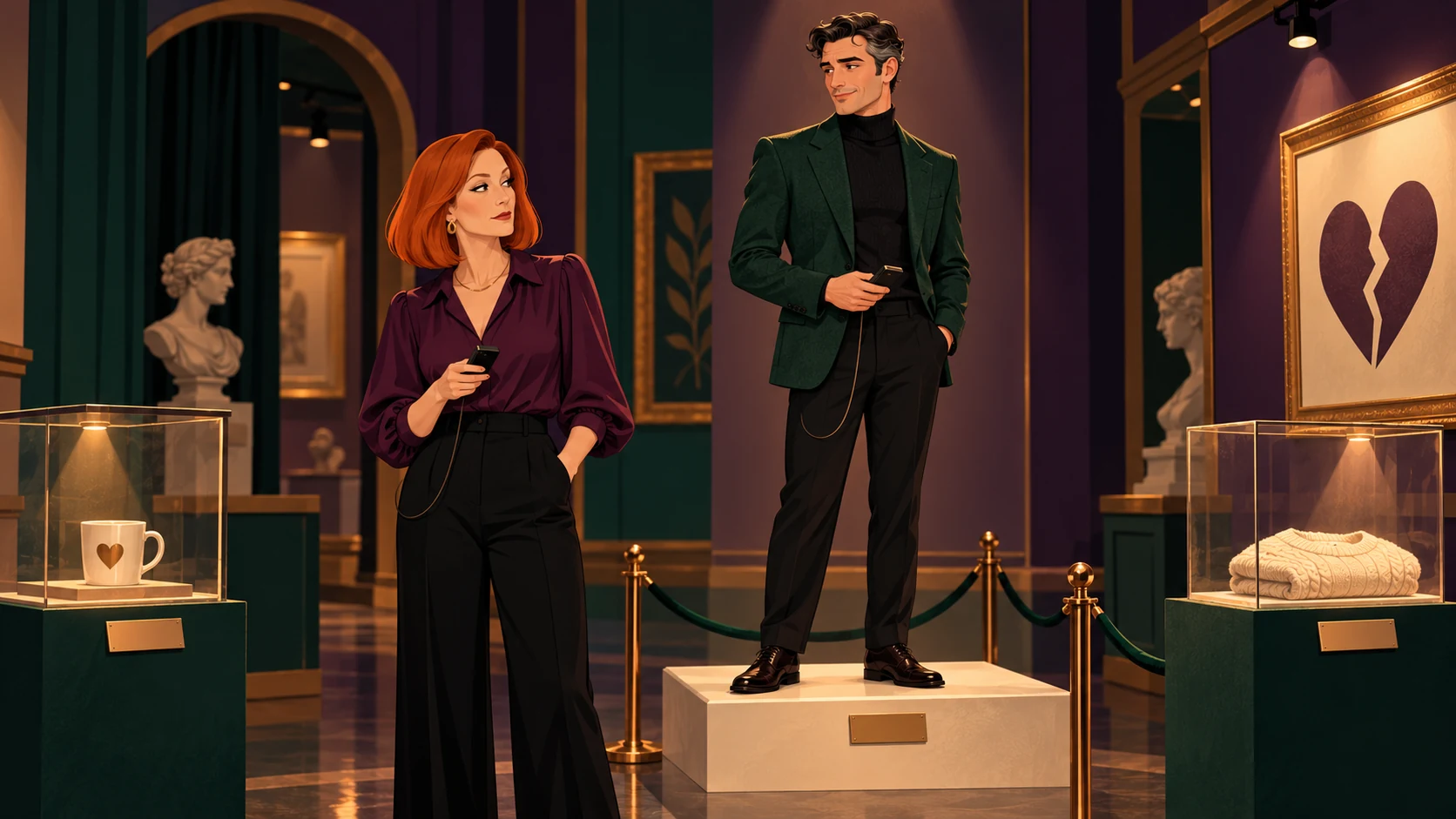
You know the symptom. You hand it a villain, and it hands you back a man with a therapist and excellent boundaries. You give it two enemies, and by chapter three they could settle the entire plot over a nice lunch. Everyone behaves as if they're angling for a five-star customer-service rating.
That isn't a lack of imagination. It's manners. A language model learns to predict what text comes next. A great deal of extra training on top of that teaches it to be a helpful, pleasant assistant. Pleasant is a design choice.1, 2 Underneath, it can produce gloriously strange material. It just won't, unless you tell it the strange stuff is wanted.
So I tell it, and I ask for a whole ladder of weird ideas, one rung at a time.
Five rungs of unhinged
Meet our gallery owner. She wants her ex to know she is completely, totally, one hundred percent over him. (She isn't.) Here's what I get when I ask for five escalating versions:
- She returns his things with museum labels explaining the disappointing history of each object.
- A private exhibition of his belongings follows, for her friends only. Purely an artistic exercise, she insists.
- The exhibition opens to the public, and he gets an invitation.
- She records an audio guide in her own voice. He records a competing one, and visitors get to choose.
- A permanent Museum of Our Relationship opens its doors, and he volunteers as a live exhibit so he can contradict her on every tour.
Rung five will probably never make it into the book. It's still the most useful thing on the list. Look at what he did: he made himself impossible to cut out of her version of their story. That's the real move. And it fits beautifully back down on rung two, at the small private show, where he turns up uninvited, with corrections.
I would never have found that by asking for "something a bit quirky."
The rules of the ladder
Escalate the action. If each rung adds more balloons and a string quartet, the only person whose life changes is the florist. Every step should make somebody try something bolder, and hand the other person a fresh way to strike back.
Explore wildly, choose carefully. Unhinged brainstorming isn't unhinged publishing. Climb the whole ladder first. Afterward, pick the rung your readers came for. In a farcical romcom, outrageous people are the point, and making them sensible too early kills the fun. In a Gothic romance, the excess you want is obsession, the kind that makes desire dangerous. In erotica, ask one question: does this make it hotter? A comic feud can turn a charged scene into a sketch in about four lines.
Unhinged still needs rules. Readers will happily believe in a relationship museum if the book has prepared them for that level of chaos and both characters have real reasons to play along. Consistency is what earns that belief.
The prompt
Here's what I actually paste in:
Using my premise, character notes, genre and tone, give me five increasingly strange versions of this situation, from slightly odd to completely unhinged. Keep the character's core desire recognizable. Each step has to change what happens or what it costs. Don't touch anything I've marked as fixed, and flag anything new you've invented.
Show me all five before you judge any of them. Then pick the most promising one for this book and tell me: Does it keep the promise my genre makes to readers? What would make it believable here? And what can I steal from the wildest version to make a tamer one better?
Then I decide how much chaos the book can hold. But before I talk the gallery owner out of her museum, I want to hear that audio guide.
- OpenAI, GPT-4 Technical Report. ↩
- Anthropic, The persona selection model. ↩